
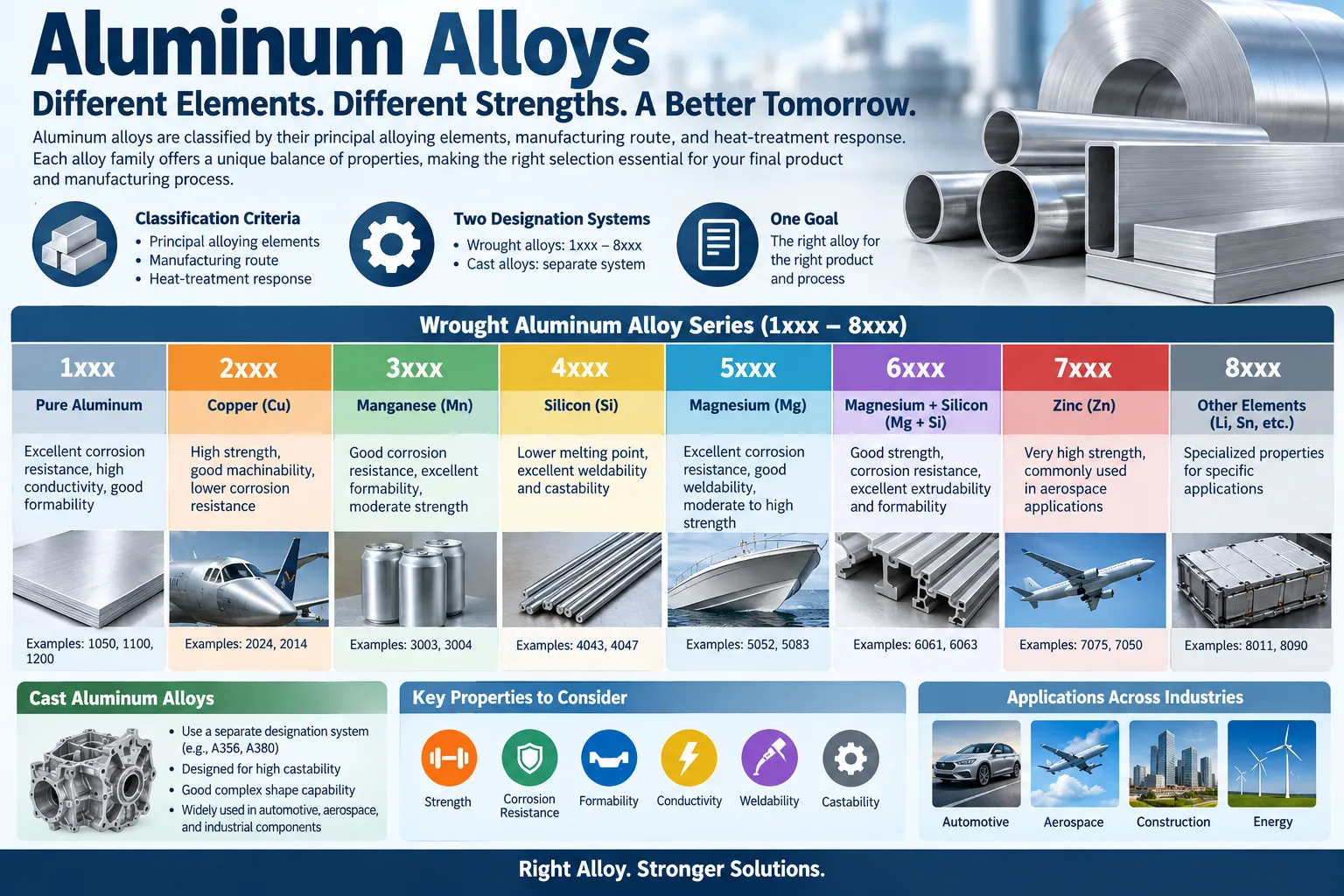
Aluminum alloys are commonly classified by their principal alloying elements, manufacturing route, and heat-treatment response. The major wrought aluminum alloy series are 1xxx through 8xxx, while cast alloys use a separate designation system. Each alloy family offers a different balance of strength, corrosion resistance, formability, conductivity, weldability, and castability, making alloy selection closely tied to the final product and manufacturing process.
How Are Aluminum Alloys Classified?
Aluminum alloys are generally divided into wrought aluminum alloys and cast aluminum alloys. The distinction is based primarily on how the alloy is processed after melting.
Wrought alloys are produced into products such as sheet, plate, foil, extrusion profiles, tubes, and forgings. Cast alloys are designed to fill a mold and solidify into a near-net-shape component.
Within wrought alloys, the first digit of the four-digit designation identifies the principal alloying element or alloy family. The commonly used series are 1xxx through 8xxx.
| Aluminum alloy series | Principal alloying element | General characteristics | Typical applications |
|---|---|---|---|
| 1xxx | Aluminum, commercially pure | High conductivity, excellent corrosion resistance, high ductility | Electrical conductors, foil, chemical equipment |
| 2xxx | Copper | High strength, good machinability, lower corrosion resistance | Aerospace structures, aircraft components |
| 3xxx | Manganese | Good formability and corrosion resistance | Heat exchangers, roofing, cookware |
| 4xxx | Silicon | Lower melting temperature, good wear characteristics | Welding filler, brazing sheet, automotive components |
| 5xxx | Magnesium | High strength, good corrosion resistance, generally non-heat-treatable | Marine structures, transportation, pressure vessels |
| 6xxx | Magnesium + silicon | Heat-treatable, balanced strength and corrosion resistance | Extrusions, automotive parts, structural profiles |
| 7xxx | Zinc | Very high strength, heat-treatable | Aerospace and high-strength structural components |
| 8xxx | Other elements | Properties depend strongly on the specific alloy | Foil, specialty and advanced applications |
The series alone, however, does not tell the whole story. Temper designation is also important because the same alloy can have substantially different mechanical properties depending on its processing and heat treatment.
What Is the Difference Between Wrought and Cast Aluminum Alloys?
The main difference is not simply the chemical composition. It is the intended manufacturing route.
Wrought alloys are formulated to withstand processes such as rolling, extrusion, forging, and drawing. They therefore need sufficient ductility and controlled deformation behavior.
Cast alloys, in contrast, must flow into a mold and solidify with acceptable shrinkage, feeding behavior, hot-cracking resistance, and surface quality. Silicon is particularly important in many casting alloys because it improves fluidity and reduces the tendency toward hot cracking.
| Characteristic | Wrought aluminum alloys | Cast aluminum alloys |
|---|---|---|
| Primary processing | Rolling, extrusion, forging, drawing | Gravity, low-pressure, high-pressure, sand or permanent-mold casting |
| Typical composition design | Emphasis on deformation behavior | Emphasis on fluidity and solidification behavior |
| Common products | Sheet, plate, foil, extrusion, forgings | Housings, wheels, engine components, structural castings |
| Heat treatment | Common for 2xxx, 6xxx and 7xxx | Common for many Al-Si and Al-Cu systems |
| Typical strength range | Broad, depending on alloy and temper | Broad, depending on alloy and casting process |
| Surface and internal quality | Strongly affected by rolling/extrusion/forging conditions | Strongly affected by melt cleanliness and solidification |
This distinction matters when choosing an alloy for a particular component. A grade that performs well as an extrusion may not be an appropriate choice for a complex casting simply because its nominal strength is higher.
What Are the Main Aluminum Alloy Series Used in Industry?
1xxx Series: High-Purity Aluminum
The 1xxx series contains at least about 99% aluminum and is selected primarily for electrical conductivity, corrosion resistance, ductility, and formability rather than high mechanical strength.
Common applications include electrical conductor products, aluminum foil, heat-transfer components, chemical equipment, and reflective materials.
For applications where conductivity is critical, relatively small changes in impurity levels can matter. Iron and silicon, for example, influence the microstructure and properties of commercially pure aluminum.
2xxx Series: Aluminum-Copper Alloys
Copper is the principal alloying element in the 2xxx series. These alloys can achieve high strength through precipitation hardening and are therefore important in aerospace and other weight-sensitive structural applications.
The trade-off is corrosion resistance. Many high-strength Al-Cu alloys require appropriate cladding, surface treatment, or corrosion-control measures when exposed to demanding environments.
3xxx Series: Aluminum-Manganese Alloys
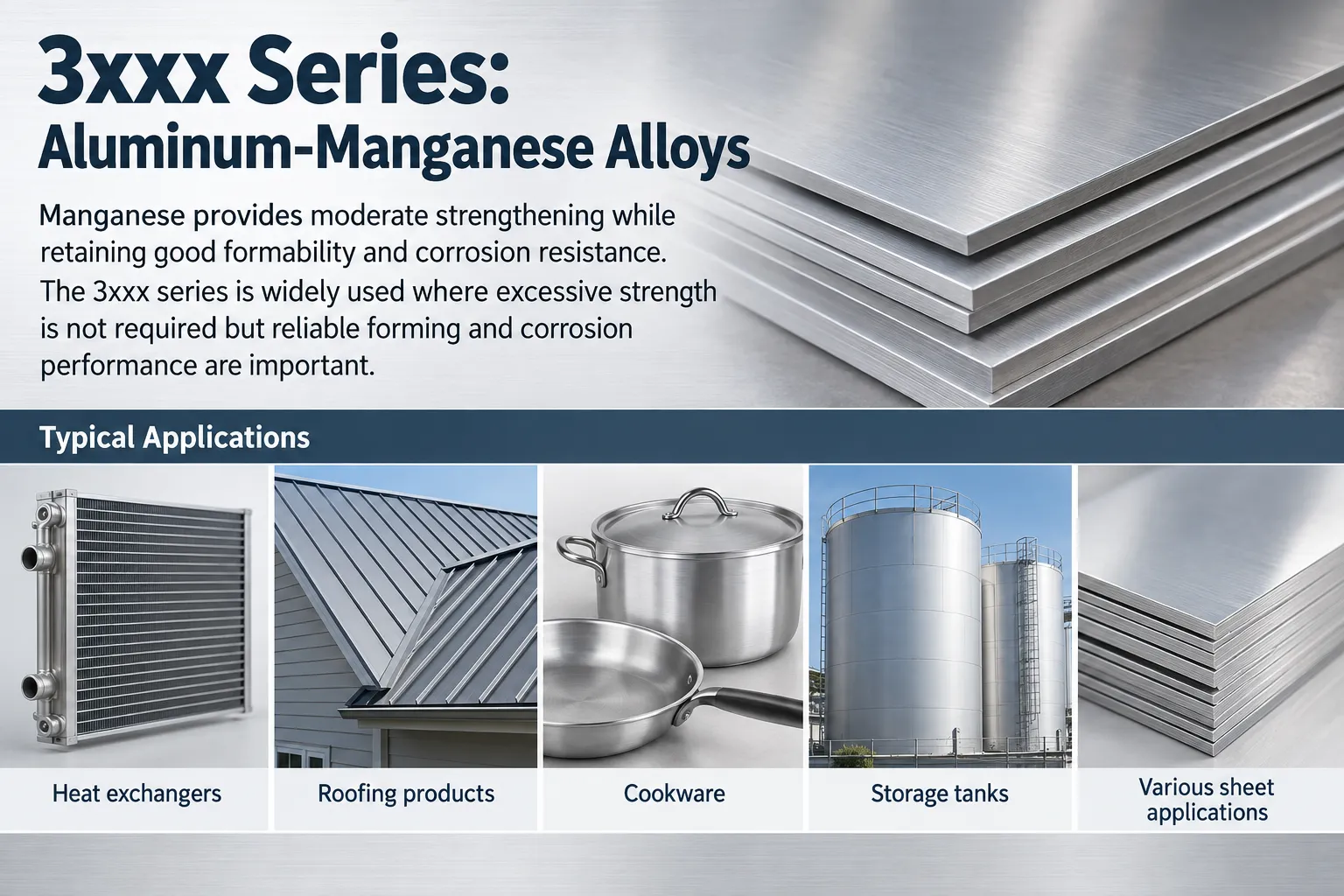
Manganese provides moderate strengthening while retaining good formability and corrosion resistance. The 3xxx series is widely used where excessive strength is not required but reliable forming and corrosion performance are important.
Heat exchangers, roofing products, cookware, storage tanks, and various sheet applications are typical examples.
4xxx Series: Aluminum-Silicon Alloys
Silicon lowers the melting temperature of aluminum alloys and improves fluidity. This makes the 4xxx series particularly useful for welding and brazing filler materials.
Certain Al-Si alloys are also used for cast components and automotive applications where wear resistance and castability are important.
5xxx Series: Aluminum-Magnesium Alloys
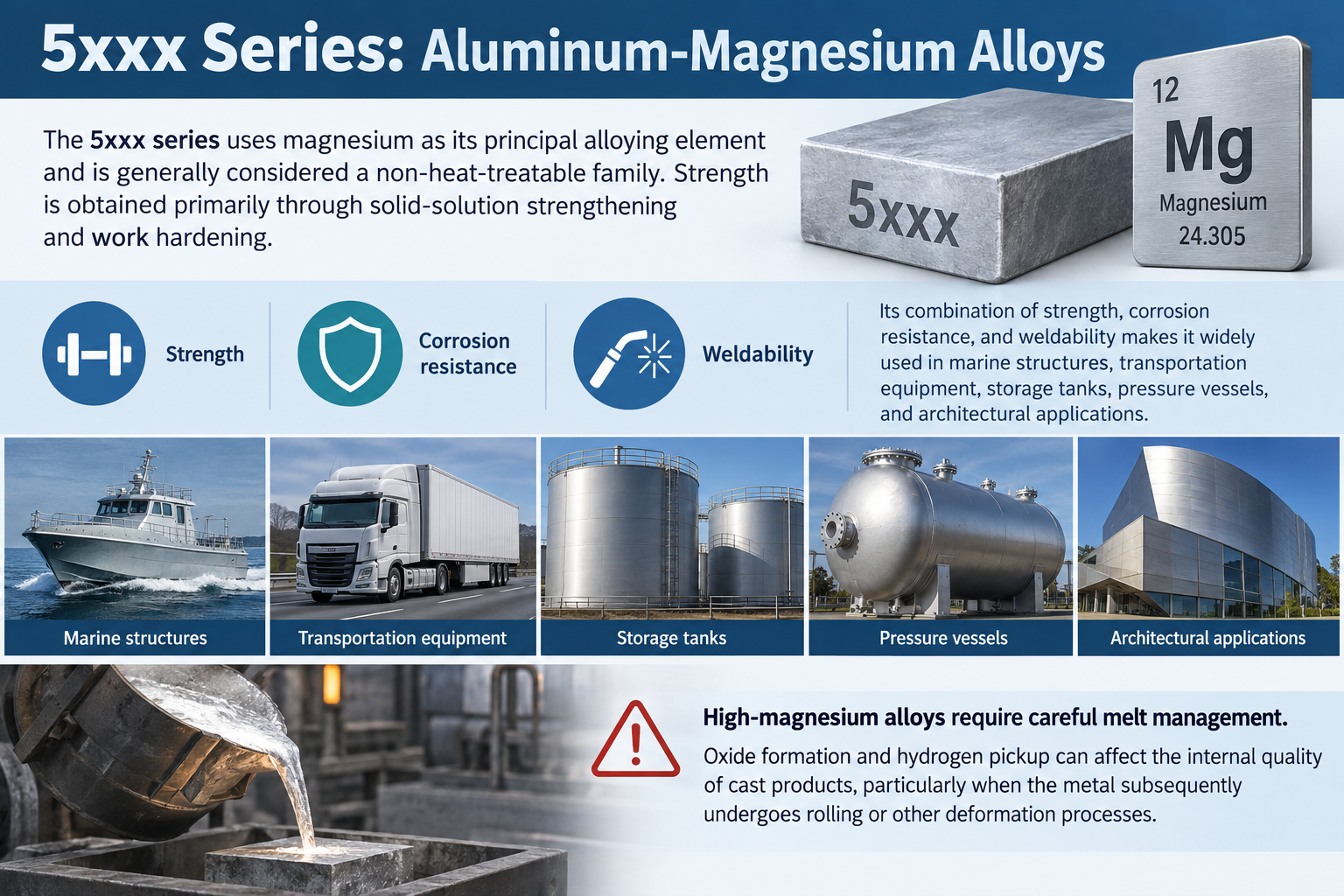
The 5xxx series uses magnesium as its principal alloying element and is generally considered a non-heat-treatable family. Strength is obtained primarily through solid-solution strengthening and work hardening.
Its combination of strength, corrosion resistance, and weldability makes it widely used in marine structures, transportation equipment, storage tanks, pressure vessels, and architectural applications.
High-magnesium alloys require careful melt management. Oxide formation and hydrogen pickup can affect the internal quality of cast products, particularly when the metal subsequently undergoes rolling or other deformation processes.
6xxx Series: Aluminum-Magnesium-Silicon Alloys
The 6xxx series is among the most widely used aluminum alloy families because it provides a practical balance of strength, corrosion resistance, formability, weldability, and extrudability.
6061 and 6063 are particularly common.
6061 offers higher structural strength and is used for machinery, transportation components, structural applications, and general engineering products. 6063 has excellent extrusion characteristics and surface finish, making it particularly common for architectural profiles and other extruded sections.
| Alloy | Main characteristics | Typical applications |
|---|---|---|
| 6061 | Good strength, corrosion resistance, machinability and weldability | Structural components, machinery, transportation |
| 6063 | Excellent extrusion and surface finish | Architectural profiles, windows, doors |
| 6082 | Relatively high strength within the 6xxx family | Structural and transportation applications |
| 6005A | Good extrusion and structural performance | Transportation and structural profiles |
For extruded products, alloy selection cannot be separated from extrusion geometry and required temper. A highly complex profile may favor an alloy with better extrusion behavior even when another alloy provides greater nominal strength.
7xxx Series: Aluminum-Zinc Alloys
The 7xxx series generally provides some of the highest strength levels among wrought aluminum alloys. Zinc is the principal alloying element, often accompanied by magnesium and, in some grades, copper.
These alloys are extensively associated with aerospace and high-performance structural applications.
The high strength comes with additional requirements for heat treatment, corrosion management, and manufacturing control. Therefore, maximum tensile strength is not automatically the deciding factor when selecting a 7xxx alloy.
8xxx Series: Specialty Aluminum Alloys
The 8xxx series covers alloys whose principal alloying additions fall outside the major conventional families.
Applications vary considerably. Aluminum-lithium alloys, for example, are designed for lightweight structural applications, while some 8xxx alloys are widely used in aluminum foil.
Because the composition and properties vary substantially across this series, the specific alloy designation must be considered rather than treating 8xxx as a single material category.
How Does Alloy Composition Affect Aluminum Alloy Performance?
Alloying elements do more than increase strength. They change solidification behavior, phase formation, electrical conductivity, corrosion resistance, machinability, weldability, and response to heat treatment.
| Alloying element | Principal effect | Typical consideration |
|---|---|---|
| Copper (Cu) | Increases strength and precipitation-hardening response | Can reduce corrosion resistance |
| Magnesium (Mg) | Strengthens aluminum and improves corrosion resistance in many alloys | Excessive levels require careful processing |
| Silicon (Si) | Improves fluidity and reduces melting temperature | Important in casting alloys |
| Manganese (Mn) | Provides solid-solution strengthening and controls microstructure | Common in non-heat-treatable alloys |
| Zinc (Zn) | Enables high-strength precipitation-hardening systems | Often combined with Mg and Cu |
| Lithium (Li) | Reduces density and increases elastic modulus | Requires specialized alloy and process control |
| Iron (Fe) | Common impurity in commercial aluminum | Can form intermetallic phases that affect properties |
The interaction between elements is often more important than the effect of an individual element. For example, magnesium and silicon together enable the precipitation-hardening response characteristic of many 6xxx alloys.
Why Does Molten Aluminum Cleanliness Matter for Alloy Performance?
Chemical composition defines an alloy grade, but cleanliness of the molten metal strongly influences the quality of the final casting or wrought product.
Non-metallic inclusions, oxide films, and dissolved hydrogen can become internal defects. In products subsequently rolled, extruded, or forged, defects introduced during casting may remain hidden until later processing or final inspection.
For this reason, melt treatment normally combines several functions rather than relying on filtration alone. Degassing can reduce dissolved hydrogen, while ceramic foam filtration can remove a significant portion of non-metallic inclusions from the molten stream.
For aluminum processing plants, filtration efficiency, melt flow stability, filter selection, and upstream melt treatment should therefore be considered together rather than as independent variables. AdTech develops ceramic foam filters and aluminum melt treatment equipment for this part of the casting process.
How Should an Aluminum Alloy Be Selected for an Application?
Alloy selection should start with the required product performance and manufacturing route rather than with tensile strength alone.
A practical selection sequence is:
- Define the manufacturing process — casting, extrusion, rolling, forging, or another route.
- Identify the required mechanical properties — strength, hardness, fatigue resistance, and ductility.
- Consider the service environment — corrosion, temperature, moisture, and chemical exposure.
- Evaluate manufacturing requirements — formability, machinability, weldability, castability, or extrusion performance.
- Select the appropriate temper or heat treatment where applicable.
- Consider surface finish and dimensional requirements for the final product.
- Assess material availability and recycling requirements for large-scale production.
| Заявка | Common aluminum alloy choices | Key selection factors |
|---|---|---|
| Aerospace structures | 2xxx, 7xxx | High strength, fatigue performance, weight |
| Автомобильные компоненты | 5xxx, 6xxx, casting alloys | Weight, formability, strength, corrosion resistance |
| Architectural extrusion | 6xxx | Extrudability, surface finish, corrosion resistance |
| Marine structures | 5xxx | Corrosion resistance, weldability |
| Электропровода | 1xxx and selected Al alloys | Electrical conductivity, weight |
| Heat exchangers | 3xxx and specialized 4xxx/3xxx combinations | Thermal performance, formability, corrosion resistance |
| Engine and transmission castings | Al-Si-based casting alloys | Castability, strength, wear and thermal performance |
Why Is There No Single “Best” Aluminum Alloy?
Aluminum alloy selection is ultimately a compromise between strength, weight, corrosion resistance, manufacturability, cost, and product requirements.
A high-strength alloy may be unsuitable when formability or corrosion resistance is the dominant requirement. Conversely, an alloy with excellent castability may not provide sufficient mechanical performance for a highly loaded structural component.
The most appropriate alloy is therefore the one whose composition, processing route, temper, and final properties match the actual service conditions.
For aluminum producers, the same principle extends back to the melt stage: controlling alloy chemistry is only part of producing consistent material. Stable melting, effective hydrogen removal, inclusion control, filtration, and casting conditions all contribute to the quality of the metal that eventually becomes an aluminum sheet, extrusion, billet, or finished component.

Старший инженер-технолог, специализирующийся на очистке алюминиевого расплава и оптимизации технологических процессов.
Основное внимание уделяется технологиям литья алюминия, обработке расплава и решениям по повышению качества, а также делится практическими рекомендациями по улучшению характеристик отливок и повышению эффективности производства.