
Ceramic foam filters (CFF) are widely used to remove non-metallic inclusions from molten aluminum before casting. Unlike a simple screen, a ceramic foam filter uses an interconnected three-dimensional pore structure to capture oxide films, alumina, spinel, carbide particles, and other suspended inclusions as aluminum flows through the filter. The right CFF is selected based on required melt cleanliness, metal flow rate, inclusion load, filter area, PPI, and casting conditions—not simply by choosing the finest pore size.
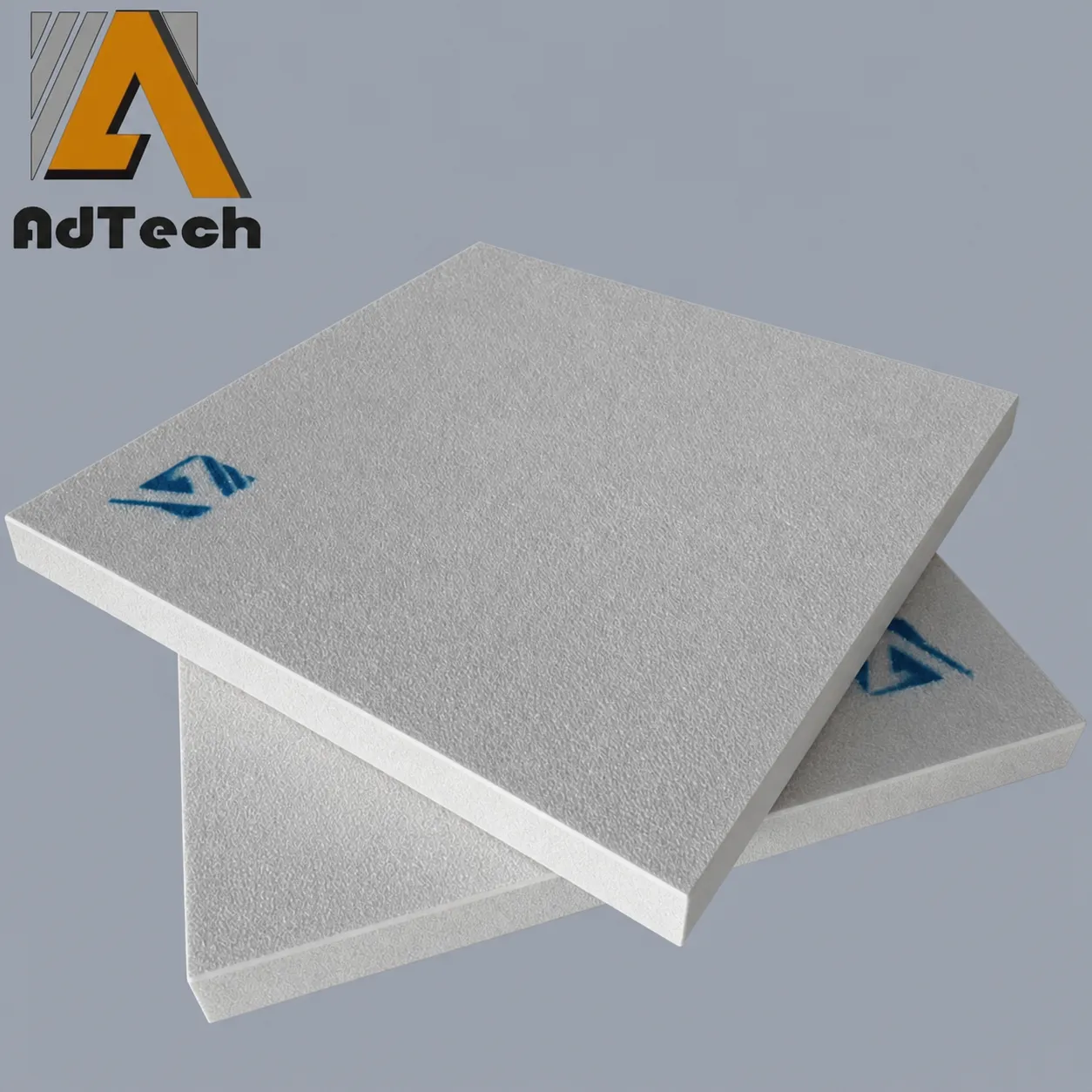
What Is a Ceramic Foam Filter?
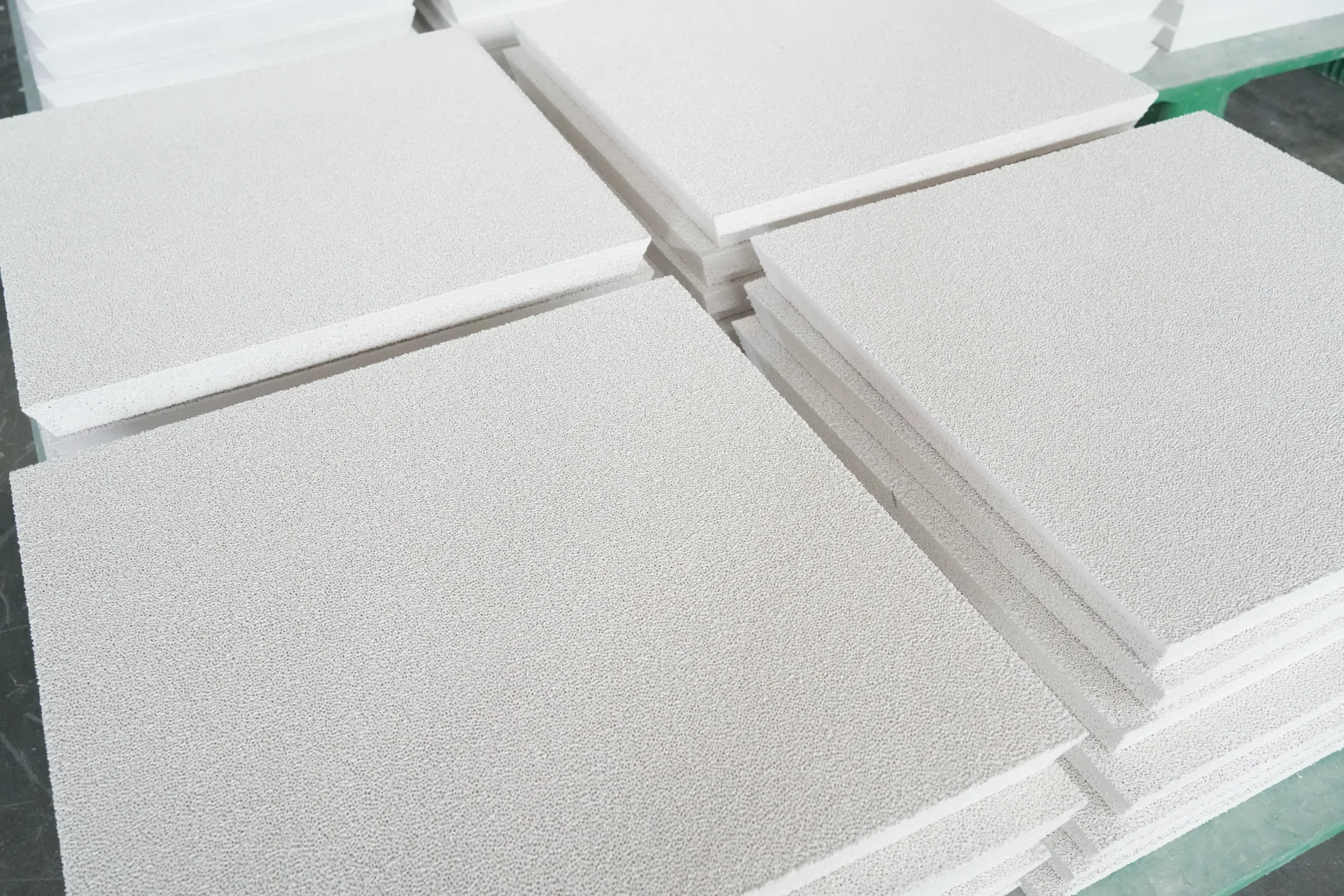
A ceramic foam filter is a porous ceramic filtration element used to clean molten metal during casting.
For aluminum applications, ceramic foam filters are commonly made from alumina-based ceramic materials because they provide the combination of thermal resistance, mechanical strength, and chemical compatibility required for molten aluminum filtration.
Unlike a conventional mesh screen, a CFF has a three-dimensional open-cell structure:
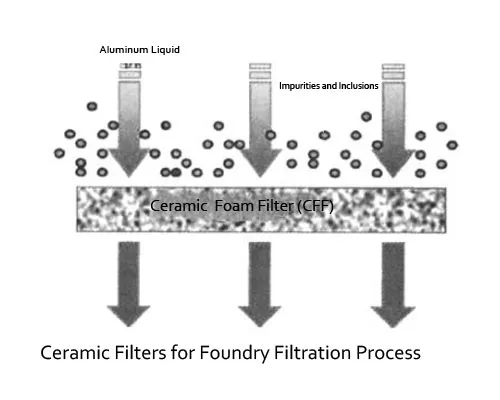
Molten aluminum → ceramic pore network → filtered aluminum
As the metal passes through the tortuous internal passages, non-metallic inclusions are captured on the filter’s cell walls and struts.
This makes CFF filtration a practical way to improve molten aluminum cleanliness immediately before casting.
What Does a Ceramic Foam Filter Remove?
The primary purpose of CFF filtration is to reduce inclusiones no metálicas, including:
- Aluminum oxide and oxide films
- Alumina particles
- Spinel inclusions
- Carbide particles
- Dross-related non-metallic particles
- Other suspended solid inclusions
These particles can become defects in the final product if they remain in the metal.
Depending on the casting application, inclusion control can help reduce problems such as surface defects, machining defects, reduced mechanical properties, and defects in downstream rolling, extrusion, or wire production.
Learn About Our Ceramic Foam Filter
¿Cómo funciona un filtro de espuma cerámica?
CFF filtration is more than simply blocking particles that are larger than the pores.
As molten aluminum travels through the interconnected ceramic structure, inclusions are captured through several mechanisms, including mechanical interception, depth filtration, and adhesion to ceramic surfaces.
Larger particles may be retained near the entrance of the filter, while smaller inclusions can travel deeper into the porous structure before contacting and adhering to the ceramic cell walls.
This three-dimensional filtration structure is why a ceramic foam filter can capture inclusions that are smaller than the nominal pore opening.
Why Doesn’t the Filter Simply Stop All the Aluminum?
Because the filter is an open-cell structure.
The objective is not to create a solid barrier. Instead, the ceramic structure provides a large internal surface area while maintaining interconnected passages through which molten aluminum can flow.
The design challenge is therefore to achieve a balance between:
Filtration efficiency ↔ metal flow capacity
A filter that is too restrictive can reduce flow and clog prematurely. A filter that is too open may allow more fine inclusions to pass through.
Can a Ceramic Foam Filter Remove Hydrogen From Molten Aluminum?
No—not in the same way as a degassing system.
This distinction is important when designing an aluminum melt treatment process.
A ceramic foam filter primarily removes solid non-metallic inclusions.
Rotary degassing, on the other hand, is used to reduce hidrógeno disuelto in molten aluminum.
In simple terms:
| Melt Treatment | Main Target |
|---|---|
| Filtro de espuma cerámica | Solid non-metallic inclusions |
| Rotary Degassing | Hidrógeno disuelto |
| Tratamiento con fundente | Oxides, dross, and specific melt-cleaning requirements |
| Dross Removal | Surface dross and entrained material |
These processes complement rather than replace each other.
A typical aluminum melt treatment sequence may therefore look like:
Melting → Alloy Adjustment → Flux Treatment → Degassing → Dross Removal → CFF Filtration → Casting
The exact sequence depends on the plant layout and casting process.
Learn About Our Molten-Aluminum Treatment
How Do You Choose the Right Ceramic Foam Filter?
Choosing a CFF should start with the proceso de fundición, not the PPI number.
A practical selection process follows several steps.
Step 1: Determine the Required Melt Cleanliness
Start by asking:
How clean does the aluminum need to be?
The answer depends on the final product.
General-purpose castings may tolerate a different inclusion level than:
- Automotive structural components
- Extrusion billet
- Aluminum foil stock
- Beverage can stock
- Electrical conductor rod
- Productos relacionados con el sector aeroespacial
The higher the cleanliness requirement, the more carefully the complete melt treatment and filtration system must be designed.
Step 2: Determine the Metal Flow Rate
The second question is:
How much molten aluminum needs to pass through the filter per unit of time?
This is one of the most important parameters in filter selection.
A filter may provide excellent filtration performance in a laboratory test but still be unsuitable for a high-throughput casting line if its effective filtration area is too small.
Higher throughput generally requires sufficient filter area to maintain an acceptable metal flow rate and avoid excessive pressure drop.
Therefore, filter size and filter quantity are just as important as PPI.
What Does PPI Mean in a Ceramic Foam Filter?
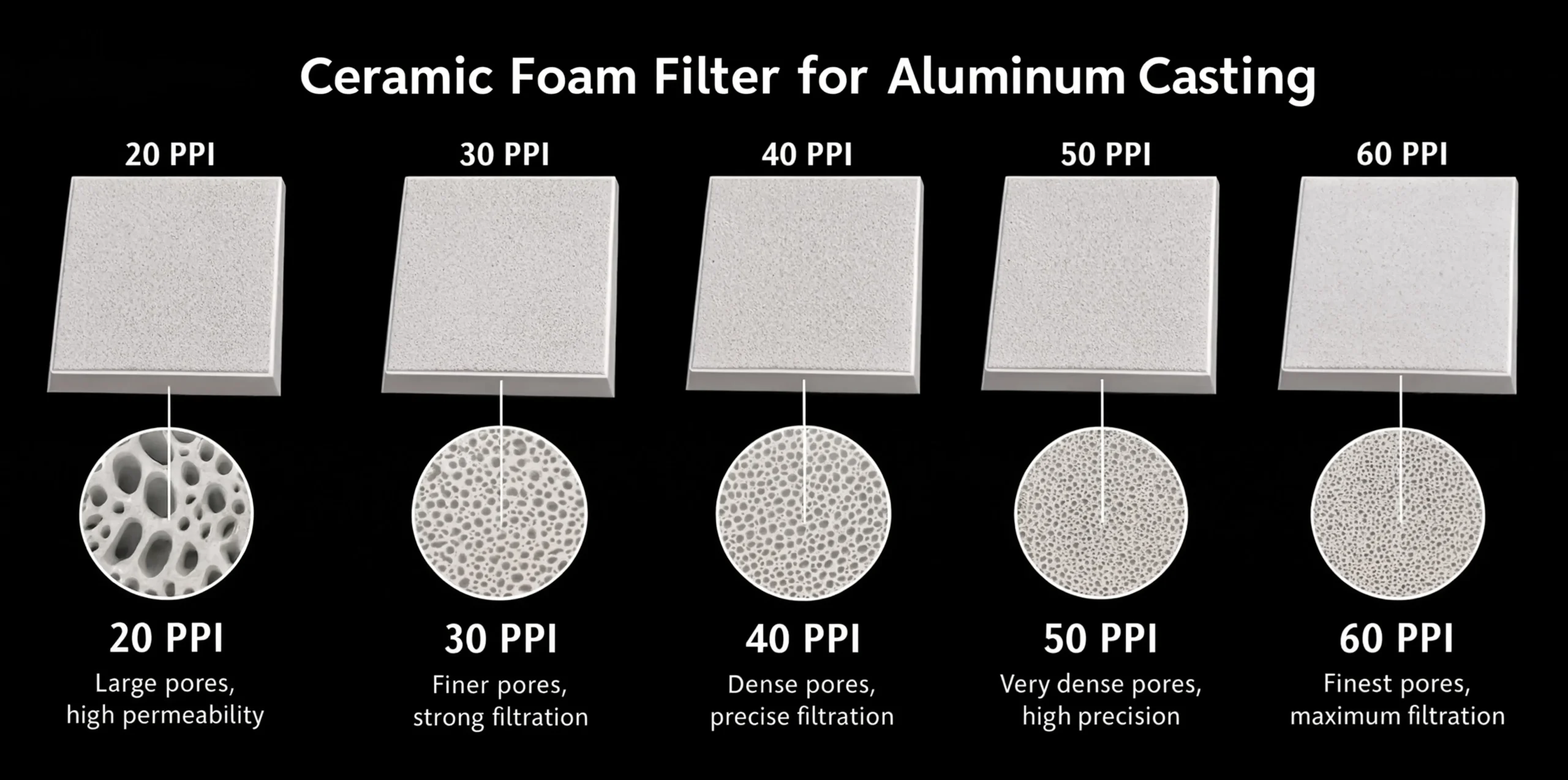
PPI means pores per inch and is commonly used to describe the pore structure of ceramic foam filters.
As a general rule:
Higher PPI → smaller and more numerous pores → finer filtration potential → greater flow resistance
This does not mean that a higher PPI filter is always better.
For example, selecting a very fine filter for a casting line with a high inclusion load and insufficient filtration area may result in:
- Faster clogging
- Reducción del flujo de metal
- Aumento de la caída de presión
- Menor vida útil del filtro
- Casting instability
Conversely, using a coarse filter where very high melt cleanliness is required may allow undesirable inclusions to remain in the metal.
The goal is therefore to select a PPI grade that matches the cleanliness target and operating conditions.
Does Higher PPI Always Mean Better Filtration?
No.
This is one of the most common misunderstandings when selecting ceramic foam filters.
Consider two hypothetical choices:
Filter A: Fine PPI, small filtration area
Filter B: Moderate PPI, larger filtration area
If the casting line has a high metal flow rate, Filter B may provide a more stable overall filtration process even though Filter A has finer pores.
This is why professional filter selection should consider:
- Required inclusion removal
- Caudal de metal
- Inclusion load
- Filter area
- PPI
- Diseño de la caja de filtros
- Expected filtration duration
The correct question is not:
“What is the highest PPI available?”
It is:
“What filtration configuration can achieve the required melt cleanliness at our actual metal flow rate?”
Why Does Filter Area Matter?
Filter area determines how much ceramic filtration surface is available for the molten metal to pass through.
If the required metal flow increases, simply increasing PPI may not be the right solution.
Increasing the effective filtration area can help maintain flow capacity by distributing the metal across a larger filtering surface.
Depending on the system, this may involve:
- A larger filter
- Multiple filters
- A larger filter box
- Parallel filtration arrangements
This is particularly important in high-throughput billet, rod, and slab casting operations, where the amount of aluminum processed per unit of time can be very large.
How Does Inclusion Load Affect Filter Selection?
Not every aluminum melt enters the filter with the same cleanliness.
Upstream processes influence the amount of material reaching the filter, including:
- Furnace operation
- Charging practices
- Tratamiento con fundente
- Desgasificación
- Eliminación de escoria
- Metal transfer
- Launder condition
- Refractory condition
If the incoming metal contains a high concentration of inclusions, the filter can accumulate captured material more quickly.
This may cause the filter to become progressively more restrictive during the casting run.
Therefore:
A filter should be selected based not only on what you want to remove, but also on how much contamination it is expected to handle.
Where Are Ceramic Foam Filters Installed?
CFFs can be used at different points in an aluminum casting system.
On-Line Filtration
In casthouse operations, the filter is commonly installed inside a dedicated filter box positioned along the molten metal flow path.
A simplified arrangement may be:
Holding Furnace → Degassing → Launder → Filter Box → Casting Machine
The exact position depends on the plant layout and melt treatment sequence.
On-line filtration is widely used for continuous and semi-continuous aluminum casting because it can process a large volume of metal before it reaches the casting zone.
Gating System Filtration
For individual foundry castings, ceramic foam filters may also be installed in the gating system.
The filter is placed in the runner or gating passage so that metal passes through it before entering the mold cavity.
This approach is common for gravity and permanent mold aluminum casting.
The required filter size and PPI depend on the casting weight, pouring rate, gating design, and required casting quality.
Why Is the Filter Box Important?
A ceramic foam filter does not work independently of the equipment around it.
A complete filtration system includes:
Filter + Filter Box + Sealing + Refractory Lining + Preheating + Metal Flow Path
The filter box must provide adequate support and sealing around the filter.
If molten aluminum bypasses the filter through an improperly sealed gap, part of the metal can reach the casting machine without being filtered.
For this reason, a suitable ceramic fiber sealing gasket or other appropriate sealing material is commonly used between the filter and filter box.
The filter box itself must also withstand the thermal and chemical conditions of molten aluminum service.
Why Does a Ceramic Foam Filter Need to Be Preheated?
A ceramic foam filter that is significantly colder than the incoming molten aluminum can experience severe thermal shock when metal first contacts it.
Preheating the filter and filter box helps:
- Reduce thermal shock
- Reduce the risk of filter cracking
- Prevent premature freezing of aluminum
- Stabilize the beginning of filtration
The exact preheating procedure depends on the filter material, filter box, casting temperature, and plant operating procedure.
The filter should be heated uniformly rather than exposed to a severe localized temperature gradient.
What Happens When a Ceramic Foam Filter Clogs?
As inclusions accumulate inside the filter, the available flow passages gradually become more restricted.
A typical sequence is:
Clean filter → Inclusion capture → Progressive accumulation → Increased flow resistance → Reduced flow capacity
Premature clogging can be caused by several factors:
1. Excessive Inclusion Load
The incoming melt may contain more inclusions than expected.
2. PPI Is Too Fine
A fine filter can restrict flow more quickly under heavy inclusion loading.
3. Filter Area Is Too Small
Insufficient filtration area forces too much metal through too little filtering surface.
4. Upstream Melt Treatment Is Insufficient
Improving degassing, flux treatment, dross removal, or furnace practices may reduce the burden placed on the filter.
This is why a clogged filter is not always a “bad filter.”
Sometimes it is evidence that the filtration system or upstream melt treatment needs to be reconsidered.
How Does CFF Filtration Differ Between Aluminum Casting Lines?
Different aluminum products impose different requirements on filtration.
Cast-Rolling Lines
Cast-rolling lines convert molten aluminum directly into relatively thin strip through a twin-roll casting process.
The process is particularly sensitive to:
- Pureza de la masa fundida
- Stable metal flow
- Temperature stability
- Calidad de la superficie
CFF selection therefore needs to balance fine inclusion control with stable flow through the caster.
Líneas de fundición de lingotes
Billets are commonly produced for subsequent extrusion.
Their quality requirements include control of:
- Inclusiones no metálicas
- Hydrogen
- Composición química
- Solidification structure
CFF filtration is one part of a broader melt treatment system, normally working together with degassing and other melt-cleaning processes.
Rod Casting Lines
Rod casting is typically a continuous, high-throughput process.
The main filtration challenge is often maintaining:
High metal throughput + consistent filtration + stable melt quality
Filter area and system capacity therefore become particularly important.
Slab Casting Lines
Slab casting produces large rectangular aluminum ingots for subsequent rolling.
Because slab casters can process very large quantities of metal, the filtration system must accommodate high throughput while maintaining the required melt cleanliness.
For these systems, filter capacity, filter area, pressure drop, and system design are often more important than simply selecting the finest available PPI.
What Are the Main Benefits of CFF Filtration?
When correctly selected and operated, ceramic foam filtration can provide several practical benefits.
Cleaner Aluminum Melt
CFF reduces suspended non-metallic inclusions before casting.
Fewer Inclusion-Related Defects
Removing inclusions can reduce defects associated with oxide films and other non-metallic particles.
Better Downstream Performance
Cleaner billet, slab, strip, or rod can provide a better starting point for subsequent processing.
More Consistent Casting
A properly designed filtration system helps maintain stable melt quality during production.
Practical On-Line Filtration
CFF systems can be incorporated into existing molten metal transfer and casting systems without fundamentally changing the casting process.
How Do You Know if a Ceramic Foam Filter Is Suitable?
Before ordering a ceramic foam filter, provide the supplier with as much process information as possible.
At minimum, consider:
| Parámetro | Why It Matters |
|---|---|
| Aluminum alloy | Affects melt treatment requirements |
| Método de fundición | Determines filtration configuration |
| Caudal de metal | Determines required filtration capacity |
| Target melt cleanliness | Helps determine filtration level |
| Filter box dimensions | Determines compatible filter size |
| Existing PPI | Provides a starting point for optimization |
| Temperatura de fundición | Important for thermal and operating conditions |
| Filtration duration | Influences filter capacity |
| Upstream melt treatment | Determines expected inclusion load |
A supplier who only asks:
“Which PPI do you need?”
may not have enough information to recommend the most appropriate filtration configuration.
A better approach is to evaluate the entire melt treatment and casting system.
Ceramic Foam Filter Specifications
AdTech ceramic foam filters can be supplied in different grades and dimensions to suit aluminum melt filtration requirements.
Typical specifications to consider include:
| Especificaciones | Selection Consideration |
|---|---|
| Ceramic material | Aluminum melt compatibility |
| PPI | Pore structure and filtration level |
| Length × Width | Available filtration area |
| Thickness | Filter box compatibility |
| Compressive strength | Mechanical reliability |
| Thermal shock resistance | Resistance during preheating and metal contact |
| Porosidad | Flow characteristics |
| Permeability | Metal flow capacity |
| Sealing gasket | Prevents metal bypass |
Actual filter dimensions and PPI should be selected according to the casting system rather than treated as universal specifications.
Why Choose AdTech Ceramic Foam Filters?
AdTech focuses on aluminum melt treatment and purification, rather than supplying ceramic filters as a generic foundry consumable.
Our ceramic foam filters are designed for aluminum casting applications where control of non-metallic inclusions and stable metal flow are important.
Depending on the casting process, CFF filtration can be integrated with other AdTech melt treatment solutions, including:
- Rotary degassing systems
- Degassing rotors
- Filter boxes
- Launder systems
- Ceramic fiber sealing materials
- Other aluminum melt purification products
This allows filter selection to be considered together with the upstream and downstream metal treatment process.
Preguntas frecuentes
1. What is a ceramic foam filter used for?
A ceramic foam filter is primarily used to remove non-metallic inclusions from molten aluminum before casting.
2. Can a ceramic foam filter remove hydrogen?
No. CFFs primarily remove solid inclusions. Dissolved hydrogen is normally controlled through a separate degassing process.
3. Does higher PPI mean better filtration?
Not necessarily. Higher PPI generally provides a finer pore structure but can also increase flow resistance and clogging risk.
4. How do I choose the right CFF PPI?
Consider the required melt cleanliness, metal flow rate, inclusion load, available filter area, and casting conditions together.
5. Why does my ceramic foam filter clog quickly?
Possible causes include excessive inclusion load, an overly fine PPI, insufficient filter area, or inadequate upstream melt treatment.
6. Why does a ceramic foam filter need preheating?
Preheating reduces thermal shock and helps prevent cracking or premature metal freezing when molten aluminum first contacts the filter.
7. Where is a ceramic foam filter installed?
CFFs can be installed in an on-line filter box or within a foundry gating system, depending on the casting process.
8. Can one ceramic foam filter be used for every aluminum casting line?
No. Cast-rolling, billet, rod, and slab casting have different flow rates and quality requirements, so filter size, PPI, and filtration capacity may need to be different.
9. What information should I provide when ordering a CFF?
Useful information includes alloy, casting method, metal flow rate, existing filter box dimensions, target cleanliness, casting temperature, and current filter specifications.
10. Is ceramic foam filtration enough to clean molten aluminum?
CFF filtration is an important inclusion-removal step, but it does not replace all melt treatment. Degassing, flux treatment, dross removal, furnace practices, and clean metal transfer may also be required depending on the application.
Need Help Selecting a Ceramic Foam Filter?
The best ceramic foam filter is not simply the one with the highest PPI. The right filtration system is the one that matches your melt cleanliness target, metal flow rate, inclusion load, filter area, and casting process.
Ponte en contacto con nosotros para recibir asesoramiento técnico
If you are selecting CFF for a billet, slab, rod, cast-rolling, or other aluminum casting line, provide your current filter dimensions, PPI, metal flow rate, alloy, and casting method. AdTech’s technical team can help evaluate the appropriate filtration configuration.

Ingeniero de procesos sénior especializado en la purificación del aluminio fundido y la optimización de procesos.
Centrado en las tecnologías de fundición de aluminio, el tratamiento del metal fundido y las soluciones para la mejora de la calidad, compartiendo conocimientos prácticos sobre cómo mejorar el rendimiento de la fundición y la eficiencia de la producción.