
Product Overview
The Rotary Flux Injection System for Molten Aluminum Degassing and Refining is an advanced melt treatment solution designed to improve molten aluminum cleanliness by combining precise flux injection, inert gas dispersion, and rotary stirring technology.
During aluminum melting and holding, impurities such as hydrogen, oxide inclusions, and non-metallic particles can negatively affect casting quality. Traditional methods, including manual flux addition, often suffer from uneven distribution, limited reaction efficiency, and inconsistent treatment results.
By injecting granular flux into molten aluminum through a controlled carrier gas system and dispersing it with a high-efficiency rotary rotor, the system enables deeper flux penetration and more uniform treatment throughout the melt. This helps aluminum producers improve refining performance, reduce casting defects, and achieve more stable production.
The Rotary Flux Injection System is widely used in aluminum foundries, casthouses, and recycling facilities where consistent molten metal quality is required.
Why Is Flux Injection Important in Aluminum Melt Treatment?
Molten aluminum easily reacts with oxygen and moisture during melting, leading to the formation of oxides and the absorption of hydrogen. In addition, alloying elements and impurities may affect the final casting performance if they are not properly controlled.
Traditional flux treatment usually relies on adding flux manually onto the molten metal surface. Although this method is simple, it has several limitations:
- Uneven flux distribution
- Limited contact between flux and molten aluminum
- Higher dependence on operator experience
- Less consistent refining results
A rotary flux injection system solves these challenges by delivering flux directly into the molten metal with controlled feeding and mechanical dispersion.
The combination of flux particles and inert gas creates better interaction between the refining agent and the aluminum melt, improving treatment efficiency and process stability.
How Does a Rotary Flux Injection System Work?
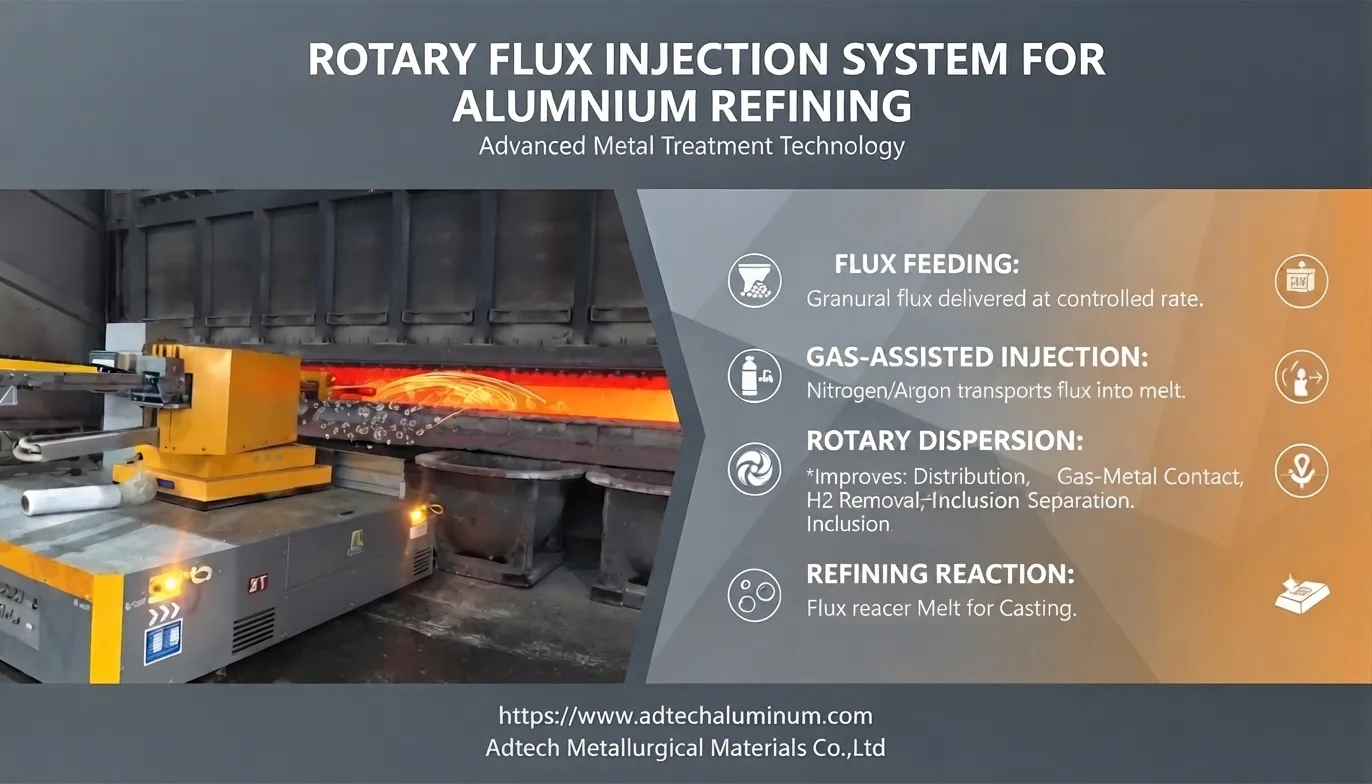
The Rotary Flux Injection System uses inert gas as a carrier medium to transport granular flux into molten aluminum. A rotating rotor then disperses the flux and gas mixture throughout the melt.
The working process includes:
1. Flux Feeding
Granular refining flux is stored in the feeding unit and delivered at a controlled rate according to process requirements.
Precise flux feeding ensures stable addition and avoids excessive flux consumption or insufficient refining treatment.
2. Gas-Assisted Injection
Nitrogen or argon is introduced as the carrier gas to transport flux particles into the molten aluminum.
The gas flow helps distribute the flux below the melt surface, allowing more effective contact with impurities.
3. Rotary Dispersion
The rotating impeller generates fine bubbles and creates circulation within the molten aluminum.
This improves:
- Flux distribution
- Gas-metal contact
- Hydrogen removal efficiency
- Inclusion separation
Compared with simple surface addition, rotary injection provides more uniform treatment throughout the melt volume.
4. Refining Reaction
Once dispersed in the aluminum melt, the flux reacts with impurities and helps remove unwanted components.
The treated melt can then proceed to filtration and casting processes with improved cleanliness.
Contact us
Main Components of Rotary Flux Injection System
Flux Feeding Unit
The flux feeding system provides accurate and stable delivery of granular flux into the molten aluminum.
Key advantages include:
- Adjustable feeding rate
- Reduced manual operation
- Improved treatment consistency
Carrier Gas System
The system uses inert gases such as nitrogen or argon to transport flux particles into the melt.
The carrier gas helps:
- Improve flux penetration
- Create effective bubble dispersion
- Enhance refining reactions
Rotary Rotor and Shaft Assembly
The rotor is one of the most important components of the system.
Its high-speed rotation generates fine bubbles and promotes molten aluminum circulation, improving the contact between flux, gas, and metal.
A well-designed rotor helps achieve:
- Uniform treatment
- Stable degassing performance
- Longer equipment service life
Control System
The control unit allows operators to adjust and monitor treatment parameters according to different alloy requirements.
The system can be customized based on:
- Furnace capacity
- Alloy type
- Production requirements
- Treatment targets
Technical Specifications
| Parameter | Specification |
|---|---|
| Application | Molten aluminum degassing and refining |
| Treatment Method | Rotary flux injection with inert gas |
| Carrier Gas | Nitrogen / Argon |
| Flux Type | Granular refining flux |
| Suitable Materials | Aluminum alloys |
| Main Function | Hydrogen removal, inclusion modification, melt refining |
Specifications can be customized according to different furnace capacities and production requirements.
Advantages of Rotary Flux Injection System
Improved Flux Utilization
Compared with traditional flux addition methods, rotary injection delivers flux deeper into the molten aluminum.
The increased contact area improves refining efficiency and allows better utilization of the flux material.
More Uniform Melt Treatment
The combination of rotor stirring and gas dispersion creates a more homogeneous treatment environment.
This helps reduce variations caused by manual operation and improves production consistency.
Reduced Aluminum Melt Defects
By improving hydrogen removal and impurity control, the system helps reduce casting issues related to poor melt quality, including:
- Gas porosity
- Inclusion defects
- Unstable casting performance
Lower Labor Dependence
The automated feeding and injection process reduces reliance on manual flux addition, improving workplace efficiency and treatment repeatability.
Rotary Flux Injection System Applications
The system is suitable for various aluminum processing applications, including:
Aluminum Casting
Used before casting operations to improve molten metal cleanliness and casting stability.
Aluminum Billet Production
Helps maintain melt quality requirements for extrusion billet manufacturing.
Automotive Aluminum Components
Supports applications requiring improved mechanical properties and reduced internal defects.
Secondary Aluminum Recycling
Provides effective refining treatment for recycled aluminum melts with higher impurity levels.
Rotary Flux Injection System vs Traditional Flux Addition
| Treatment Method | Limitations |
|---|---|
| Manual flux addition | Uneven distribution and limited melt penetration |
| Flux tablets | Lower flexibility and slower reaction |
| Simple gas injection | Limited refining effect without flux dispersion |
| Rotary flux injection | Controlled feeding, deeper treatment, and better consistency |
The Rotary Flux Injection System provides a more controlled approach by combining flux delivery and melt agitation in one integrated process.
Integrated Solution for Cleaner Aluminum Production
For modern aluminum producers, melt treatment is not limited to a single process. Achieving high-quality aluminum usually requires a combination of refining, degassing, filtration, and flow control technologies.
A complete aluminum melt treatment process may include:
- Rotary Flux Injection System for refining and hydrogen control
- Degassing equipment for dissolved gas removal
- Ceramic foam filters for inclusion filtration
- Launder systems for stable metal transfer
By integrating these technologies, aluminum producers can improve melt cleanliness and maintain stable casting performance.
Why Choose AdTech Rotary Flux Injection System?
AdTech specializes in aluminum melt treatment solutions, providing equipment and materials designed for modern aluminum casting operations.
Our Rotary Flux Injection System features:
- Professional aluminum melt treatment experience
- Stable equipment performance
- Customized solutions for different casting requirements
- Strict quality control during manufacturing
- Support for integrated melt purification systems
With advanced equipment design and industry-focused solutions, AdTech helps aluminum producers achieve cleaner molten metal and more reliable casting results.
Frequently Asked Questions
1. What is a rotary flux injection system?
A rotary flux injection system is an aluminum melt treatment system that injects granular flux into molten aluminum through a carrier gas and disperses it with a rotating rotor. It improves flux distribution, enhances refining reactions, and helps remove impurities such as hydrogen and oxide inclusions.
2. How does a rotary flux injection system work?
The system uses nitrogen or argon as a carrier gas to deliver granular flux into molten aluminum. A rotating rotor creates fine bubbles and metal circulation, allowing the flux to contact the melt more evenly and improving refining efficiency compared with surface flux addition.
3. Why use flux injection instead of manual flux addition?
Flux injection provides more controlled and uniform treatment than manual flux addition. By delivering flux deeper into the molten aluminum, it improves flux utilization, reduces operator dependence, and helps achieve more consistent melt quality.
4. What problems can a rotary flux injection system solve in aluminum casting?
A rotary flux injection system helps reduce common molten aluminum quality issues, including hydrogen-related porosity, oxide inclusions, and unstable casting performance. It improves melt cleanliness by enhancing flux-metal contact and refining efficiency.
5. Can a rotary flux injection system remove hydrogen from molten aluminum?
Yes. The system can assist hydrogen removal by improving the contact between refining flux, inert gas, and molten aluminum. For applications requiring higher degassing performance, it is often combined with dedicated rotary degassing equipment and ceramic foam filtration systems.
6. What type of flux is used in a rotary flux injection system?
Rotary flux injection systems typically use granular refining flux designed for aluminum melt treatment. The suitable flux depends on factors such as aluminum alloy type, furnace conditions, impurity levels, and required melt quality.
7. What is the difference between flux injection and rotary degassing?
Flux injection focuses on delivering refining agents into molten aluminum to improve impurity removal and melt treatment efficiency. Rotary degassing mainly removes dissolved hydrogen using inert gas bubbles. Both processes can be combined for better molten aluminum cleanliness.
8. Where are rotary flux injection systems used?
Rotary flux injection systems are used in aluminum foundries, aluminum casthouses, billet production plants, and secondary aluminum recycling facilities. They are suitable for operations requiring stable melt quality and improved casting performance.
9. How do I choose a rotary flux injection system for my aluminum furnace?
The correct system depends on furnace capacity, alloy type, production requirements, flux consumption, and desired treatment results. A customized configuration is recommended to match different aluminum melting and casting conditions.
10. Why choose AdTech rotary flux injection system?
AdTech rotary flux injection systems are designed for aluminum melt treatment applications, combining controlled flux feeding, inert gas delivery, and rotary dispersion technology. We provide customized solutions to help aluminum producers improve melt cleanliness and maintain stable casting quality.

Senior Process Engineer specializing in aluminum melt purification and process optimization.
Focused on aluminum casting technologies, molten metal treatment, and quality improvement solutions, sharing practical insights into improving casting performance and production efficiency.