
High-magnesium aluminum alloys can attack degassing box linings more aggressively because magnesium increases the chemical reactivity of the molten alloy toward certain refractory materials. When the lining contains silica or aluminosilicate phases, reactions can produce magnesium aluminate spinel (MgAl₂O₄), alumina, and other reaction products. Changes in the lining’s microstructure, combined with molten metal penetration and cracking, can accelerate corrosion, cause refractory spalling, and shorten lining service life.
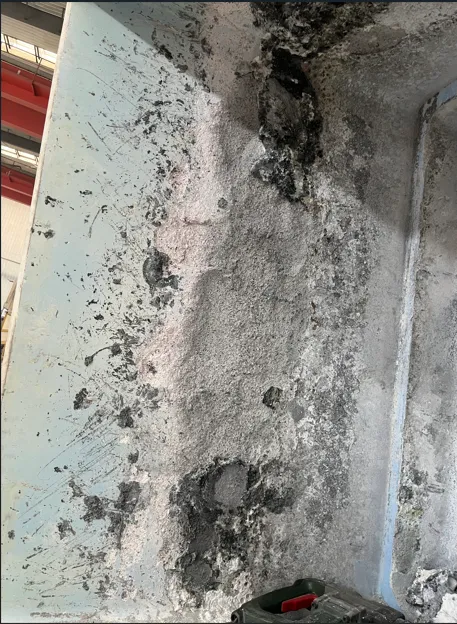
Why Is High-Magnesium Aluminum More Aggressive Toward Refractory Linings?
The key difference lies in the chemical behavior of magnesium at molten aluminum temperatures. Magnesium is a reactive alloying element and can participate in reduction reactions involving oxide-bearing refractory materials. As the Mg content increases, the potential for chemical interaction between the molten alloy and susceptible silica-containing linings becomes more significant.
The extent of corrosion depends on more than Mg concentration alone. Refractory composition, open porosity, crack density, operating temperature, contact time, and melt movement all influence the rate and depth of degradation.
| Corrosion stage | Underlying mechanism | Consequence for the lining |
|---|---|---|
| Chemical attack | Magnesium reacts with susceptible oxide phases in silica-bearing or aluminosilicate refractories | Original refractory phases are altered or consumed |
| Metal penetration | Molten alloy enters connected pores and microcracks | Corrosion progresses beneath the hot face |
| Reaction-product formation | MgAl₂O₄ spinel and alumina-containing phases develop under suitable chemical conditions | Local volume changes and microstructural stress can occur |
| Crack propagation | Reaction damage interacts with thermal and mechanical stresses | Cracks extend deeper into the refractory |
| Spalling and material loss | Weakened layers separate from the lining | Lining thickness decreases and fresh material is exposed |
This sequence explains why some linings deteriorate progressively rather than showing only superficial wear. Once cracks and connected penetration paths develop, the reaction front can move deeper into the refractory and expose additional material to attack.
How Does Magnesium React With Silica-Containing Linings?
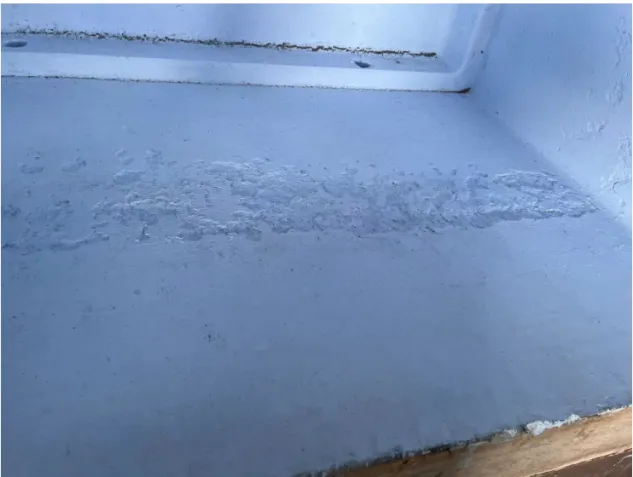
Many refractory materials used in aluminum processing contain silica (SiO₂), aluminosilicate phases, or both. These materials can offer useful thermal and mechanical properties, but their chemical compatibility with molten aluminum-magnesium alloys must be considered carefully.
Magnesium changes the reaction environment at the metal–refractory interface. Rather than acting only as a source of physical wear, it participates in chemical reactions that modify the original refractory structure.
1. Why Can Magnesium Promote Internal Refractory Degradation?
At high temperatures, molten aluminum-magnesium alloys can penetrate porous refractory structures and react with their constituents. Open pores and microcracks provide pathways for metal infiltration. Once the alloy reaches reactive silica-bearing phases, chemical changes can occur within the lining rather than only at its exposed surface.
Magnesium also has a relatively high vapor pressure at aluminum processing temperatures. Vapor-phase species may contribute to reactions in hot regions exposed above the melt surface, depending on the operating conditions and the lining structure. However, vapor penetration should not be treated as the sole or universal cause of corrosion; direct contact and penetration by the molten alloy are also important mechanisms.
2. What Happens When Magnesium Encounters Silica?
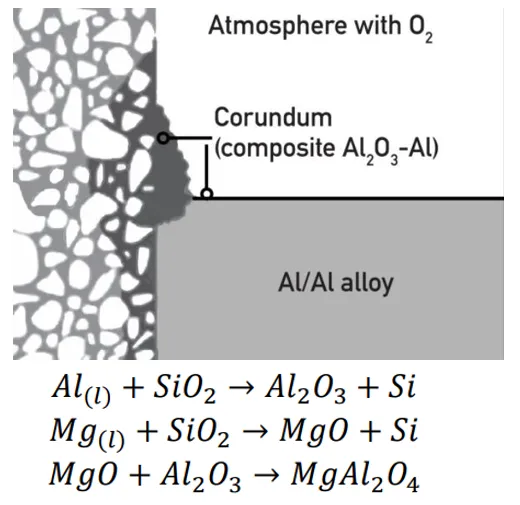
The chemistry is more complex than a single reaction in which magnesium simply removes silica and produces corundum.
Molten aluminum can reduce silica, producing silicon that can enter the metal and alumina that remains in the refractory reaction zone. In the presence of magnesium, additional reactions can produce MgO and magnesium aluminate spinel, depending on the local composition and oxygen availability.
Experimental research on molten Al–Mg alloys contacting alumina-silica refractories has identified MgAl₂O₄ spinel and alumina among the reaction products. The order and extent of phase formation depend on the alloy and refractory composition. Research published in the Journal of the Japan Institute of Light Metals examined the internal degradation of an alumina-silica refractory exposed to molten Al–5Mg alloy.
3. Why Can Reaction Products Weaken the Lining?
Chemical reactions change the phases, pore structure, and local volume of the refractory. Some reactions can create voids or reduce the integrity of the original matrix, while the formation of other phases can generate local stresses.
These changes can work together. A damaged region allows more molten alloy to penetrate; further reactions alter the surrounding material; and the resulting cracks create additional pathways for penetration.
The important point is that refractory corrosion is a coupled process involving chemistry, transport through the material, and structural damage—not simply the disappearance of one ingredient.
Why Does Magnesium Aluminate Spinel Contribute to Lining Cracking?
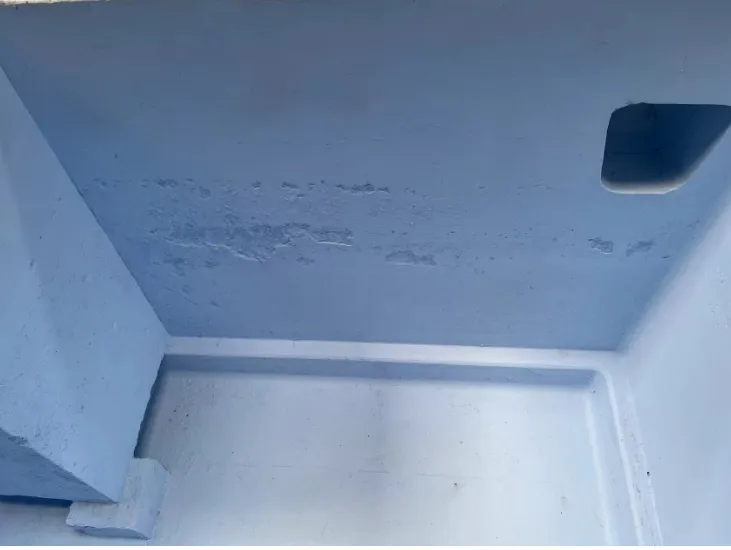
Magnesium aluminate spinel, MgAl₂O₄, is a crystalline oxide phase that can form when magnesium reacts with alumina-bearing refractory materials under suitable conditions. Spinel itself is a useful refractory material in many engineered applications. Its presence is not automatically evidence of damage.
The problem arises when spinel forms in situ within a refractory whose original microstructure and phase distribution were not designed to accommodate the resulting transformations. Local volume changes and reaction stresses can disrupt the matrix, particularly when combined with thermal gradients and pre-existing cracks.
| Microstructural change | Potential effect | Possible operational consequence |
|---|---|---|
| Formation of MgAl₂O₄ spinel | Changes local phase composition and may generate reaction stress | Microcracking |
| Formation of alumina-rich reaction zones | Changes the original refractory microstructure | Local differences in strength and volume |
| Reduction of silica-bearing phases | Can alter the matrix and generate voids | Greater susceptibility to metal penetration |
| Growth of interconnected cracks | Creates additional pathways for molten alloy | Deeper internal corrosion |
| Separation of damaged layers | Removes part of the working surface | Faster loss of effective lining thickness |
A 2020 review of aluminosilicate refractory corrosion reported that the formation of spinel and corundum phases, together with molten Al–Mg penetration, can contribute to crack development and severe refractory degradation. Read the peer-reviewed review in Materials.
For a degassing box, the practical concern is not merely whether a reaction product forms. It is whether the combined chemical and physical changes compromise the lining’s integrity during repeated operating cycles.
What Are the Warning Signs of High-Magnesium Alloy Corrosion?
The appearance of a refractory lining can provide useful clues, although visual inspection alone cannot establish the chemical mechanism. Different damage modes may occur together, and the correct diagnosis should consider the lining composition, operating history, and alloy chemistry.
| Observed condition | Possible explanation | What should be investigated |
|---|---|---|
| Localized surface recession | Chemical attack or erosion | Contact conditions, alloy composition, metal movement |
| Rough, altered hot-face material | Reaction-product formation or surface degradation | Refractory composition and operating temperature |
| Cracks extending below the surface | Reaction damage, thermal stress, or both | Crack distribution and thermal cycling history |
| Layered peeling or spalling | Separation of weakened refractory layers | Damage depth, bonding integrity, and phase changes |
| Increasing refractory debris | Progressive lining deterioration | Debris composition, corrosion locations, and maintenance records |
These observations should be interpreted in context. For example, cracking can result from thermal shock even without severe chemical attack. Conversely, chemical corrosion can weaken the lining before significant spalling becomes visible.
Where failure is recurring, laboratory examination of used refractory material can help identify spinel, alumina-rich reaction products, altered silica-bearing phases, or metal penetration. X-ray diffraction and microscopy with elemental analysis are among the methods used in refractory corrosion studies.
Which Operating Conditions Accelerate Degassing Box Lining Corrosion?
High magnesium content increases the potential for chemical attack, but actual lining life depends on the complete operating environment. A suitable assessment should consider both the molten alloy and the material exposed to it.
| Factor | Why it matters | Implication for lining selection |
|---|---|---|
| Magnesium concentration | Influences the chemical reactivity of the Al–Mg melt | Verify compatibility with the actual alloy range |
| Operating temperature | Affects reaction kinetics and transport processes | Assess performance at the real service temperature |
| Lining composition | Determines which refractory phases can react with the melt | Examine silica content and other reactive constituents |
| Open porosity and microcracks | Provide pathways for metal infiltration | Consider permeability, density, and structural integrity |
| Contact time | Influences the duration of chemical exposure | Evaluate corrosion resistance under realistic service cycles |
| Melt movement | Can intensify material loss and transport at the interface | Account for local flow and erosion conditions |
| Thermal cycling | Creates expansion and contraction stresses | Assess thermal shock resistance and installation practice |
No single factor predicts service life reliably. For example, a lining with good initial chemical resistance may still deteriorate under severe thermal cycling, while a dense refractory can remain vulnerable if its chemistry is unsuitable for the alloy.
The most useful assessment compares the actual operating conditions with the refractory’s verified material properties and service history.
How Can Refractory Corrosion Be Reduced When Processing High-Magnesium Aluminum?
The first step is to confirm that chemical incompatibility, rather than installation defects, thermal shock, or mechanical erosion alone, is driving the damage.
For a lining exposed to high-magnesium aluminum, several measures deserve consideration:
- Review the refractory composition. Determine whether silica-bearing or aluminosilicate phases are suitable for the actual Al–Mg alloy and operating conditions.
- Examine porosity and penetration resistance. Connected pores and microcracks can allow molten alloy to reach internal reaction sites.
- Evaluate phase stability. Material selection should account for possible spinel formation and other reactions with the molten alloy.
- Check the thermal cycle. Preheating, operating temperature, shutdown, and reheating practices can influence cracking and spalling.
- Investigate recurring failure locations. Damage concentrated near metal-contact regions may point to a different mechanism from damage caused mainly by installation or temperature gradients.
Some refractory formulations incorporate non-wetting additives or are designed with different oxide ratios to improve resistance to molten aluminum alloys. Their suitability must be established for the particular application; an additive that performs well in one test system does not guarantee the same result in every degassing box.
What Does High-Magnesium Alloy Corrosion Mean for Degassing Box Service Life?
The central issue is the interaction between a chemically reactive melt and a refractory lining whose composition and microstructure determine its resistance.
When magnesium reacts with susceptible silica-bearing phases, and molten alloy penetrates the lining, reaction products and structural changes can promote cracking. Once damaged layers begin to separate, fresh material becomes exposed and the process can continue beneath the original working surface.
For aluminum processing plants, lining selection should therefore be based on the actual magnesium content, operating temperature, exposure conditions, and evidence from previous service—not on maximum temperature ratings alone.
Understanding these mechanisms provides a sounder basis for diagnosing premature lining failure, comparing refractory options, and reducing unplanned maintenance in degassing equipment used for high-magnesium aluminum alloys.
FAQ
1. Why do high-magnesium aluminum alloys corrode degassing box linings?
Magnesium can react with silica-containing refractory materials at elevated temperatures. These reactions, combined with molten metal penetration and thermal stress, can weaken the lining and accelerate corrosion.
2. How does magnesium react with silica in refractory linings?
Magnesium can participate in reduction reactions involving silica-bearing phases. Depending on the local conditions, reaction products may include alumina, magnesium oxide, and magnesium aluminate spinel.
3. What is magnesium aluminate spinel (MgAl₂O₄)?
Magnesium aluminate spinel is a crystalline oxide phase that can form when magnesium-containing melts react with alumina-bearing materials. Its formation within an unsuitable refractory structure can contribute to local stress and cracking.
4. Why does refractory lining corrosion lead to spalling?
Chemical reactions can alter the refractory’s original microstructure, while molten metal penetration and thermal stress promote crack growth. Damaged layers may eventually separate from the lining surface.
5. Does higher magnesium content always mean faster refractory corrosion?
Not necessarily. Higher magnesium content can increase the potential for chemical attack, but the actual corrosion rate also depends on refractory composition, temperature, porosity, exposure time, and operating conditions.
6. Are silica-containing refractories suitable for high-magnesium aluminum alloys?
Their suitability depends on the specific composition and operating conditions. Because magnesium can react with silica-bearing phases, refractory compatibility should be verified for the actual alloy and service environment.
7. How can operators identify refractory corrosion in a degassing box?
Warning signs include surface deterioration, deep cracks, localized material loss, layered spalling, and increasing refractory debris. Material analysis may be needed to distinguish chemical attack from thermal shock or mechanical erosion.
8. How does operating temperature affect refractory corrosion?
Temperature influences reaction kinetics, metal behavior, and thermal stress. Excessive temperatures or severe temperature cycling can accelerate deterioration when the lining material is not suitable for the operating conditions.
9. How can refractory corrosion be reduced when processing high-magnesium aluminum alloys?
Review the refractory’s chemical compatibility, porosity, penetration resistance, and thermal stability. Correct preheating, controlled operating conditions, and regular lining inspections can also help reduce premature deterioration.
10. What should be considered when selecting a refractory lining for a high-magnesium aluminum degassing box?
Evaluate the alloy’s magnesium content, operating temperature, refractory composition, resistance to molten aluminum penetration, thermal cycling performance, and service history under comparable conditions.

Senior Process Engineer specializing in aluminum melt purification and process optimization.
Focused on aluminum casting technologies, molten metal treatment, and quality improvement solutions, sharing practical insights into improving casting performance and production efficiency.